
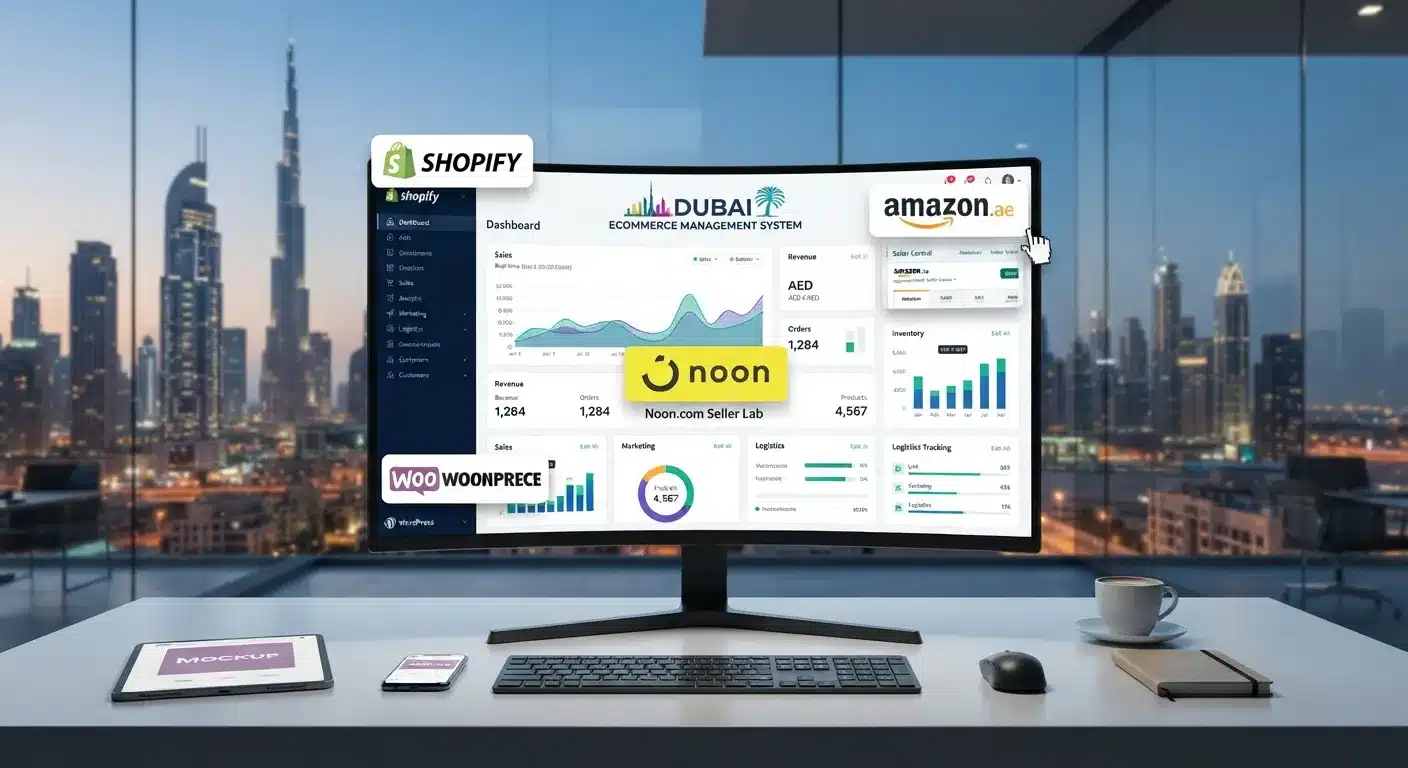
An ecommerce management system in Dubai is the software that runs the back end of an online store: it tracks inventory, processes orders, accepts UAE payment methods (cards, wallets, BNPL, and cash on delivery), books couriers, and produces VAT-compliant tax invoices. For Dubai businesses, the most important features are local payment gateways, courier integration, 5% VAT invoicing, and syncing stock with marketplaces like Noon and Amazon.ae.
If you run a shop, a brand, or a trading business in Dubai and you've started selling online, you've probably felt it: orders arriving on WhatsApp, Instagram, and the website at the same time, stock counts in an Excel sheet that's never quite right, and invoices typed out by hand. That's the exact problem an ecommerce management system in Dubai is built to solve. This guide explains what one is, what it should do for a local business, and how to choose the right setup.
An ecommerce management system is the control centre behind your online store. Your customers see the storefront: product pages, a cart, a checkout. The management system is everything behind it, the part that decides whether an order is in stock, whether payment went through, which courier picks it up, and what goes on the invoice.
For a small store, this might be the admin dashboard of WooCommerce or Shopify with a few plugins or apps added. For a larger business, it can include an ERP or accounting system connected to the store. Either way, the goal of an ecommerce management system in Dubai is the same: one place where every order, product, and dirham is tracked, instead of five disconnected tools.
Selling online in Dubai has some local realities that generic ecommerce advice doesn't cover. A good ecommerce management system in Dubai has to handle all of them:
One order, handled automatically from checkout to tax invoice — that's the job of the system.
The foundation of any ecommerce management system in Dubai: real-time stock counts that update the moment something sells, low-stock alerts, and support for product variants (sizes, colours, storage options). If you also have a physical shop in Dubai, your online and in-store stock should come from the same numbers.
Every order in one dashboard, whatever channel it came from, with clear statuses: pending, paid, packed, shipped, delivered, returned. This is where you stop losing orders that came in on WhatsApp at midnight.
Integration with gateways that work for UAE businesses, such as Telr, PayTabs, Network International, or Stripe, plus BNPL options like Tabby and Tamara and a proper cash-on-delivery flow. COD orders should be tracked separately so you know exactly how much cash your courier is holding.
Direct connection to local couriers such as Aramex, Emirates Post, or on-demand delivery services, so shipping labels and tracking numbers are generated automatically and the customer gets an update without you sending it by hand.
Automatic tax invoices showing your TRN, the 5% VAT amount, and the details the Federal Tax Authority requires. Your records should also export cleanly for your accountant when it's time to file your VAT return with the Federal Tax Authority.
If you sell on Noon, Amazon.ae, Instagram, or WhatsApp as well as your own website, stock needs to sync across all of them. Selling the same last unit twice on two channels is one of the most common and costly mistakes we see.
Sales reports by product, channel, and period; your best customers and repeat buyers; return rates; COD rejection rates. This is the data your ecommerce management system in Dubai should hand you, telling you what to reorder, what to promote, and which ad campaigns are actually paying off.
The UAE is introducing a national e-invoicing system, and it affects how your ecommerce management system in Dubai should handle invoices if you sell to other businesses. According to the UAE Ministry of Finance, an e-invoice is structured invoice data exchanged electronically and reported to the Federal Tax Authority, and PDFs, Word files, scanned copies, and emailed images do not count as e-invoices.
The key dates under the current Ministry of Finance timeline are:
The mandate covers business-to-business (B2B) and business-to-government sales, while business-to-consumer (B2C) sales are currently out of scope. So if your online store only sells to the public, your day-to-day checkout won't change yet. But if you also supply trade customers, resellers, or companies, your system will need to connect with an ASP. It's worth planning this into any new ecommerce management system in Dubai now rather than rebuilding later. Confirm your specific obligations with your accountant, as the rules may be updated.
| Factor | WooCommerce (WordPress) | Shopify | Custom Build |
|---|---|---|---|
| Ownership | You own the site and data; self-hosted | Hosted platform; monthly subscription | Fully owned; built to your spec |
| UAE payment gateways | Wide plugin choice (Telr, PayTabs, Network, Stripe, Tabby, Tamara) | Supported via Shopify Payments or third-party apps | Any gateway with an API |
| Cash on delivery | Built in, easy to customise | Built in as a manual payment method | Built to your rules |
| Arabic / English | Via multilingual plugins, full RTL support | Built-in multi-language with translation apps | Designed in from the start |
| Flexibility | Very high: custom fields, B2B pricing, vendor accounts | High within Shopify's app ecosystem | Unlimited, but highest cost and build time |
| Best for | Most Dubai SMEs wanting control and lower running costs | Brands wanting fast launch and minimal tech upkeep | Large catalogues or unusual workflows |
For most small and medium businesses, WooCommerce or Shopify with the right integrations makes a complete ecommerce management system in Dubai. A fully custom system usually only makes sense once your processes are too specific for existing platforms.
There is no single best ecommerce management system in Dubai for every business. The best one is the system that fits your catalogue size, sales channels, and budget, and that connects cleanly with UAE payment gateways, local couriers, and VAT invoicing. As a simple rule:
The cost of an ecommerce management system in Dubai depends on what you connect, not just the platform you pick. Rather than one fixed price, budget for these parts:
For real 2026 prices on each of these, plus a free calculator, read our guide to the ecommerce website cost in Dubai.
Setup time also depends on scope: how many products you have, how clean your product data is, and how many systems need to be connected. A straightforward single-channel store is much faster to launch than a multi-channel setup with ERP and marketplace sync.
These two are often confused in search. An ecommerce management system is the software that runs your store. An ecommerce store management service is a team that runs the store for you: uploading products, writing descriptions, updating prices and stock, processing orders, and keeping the site healthy. Many Dubai business owners need both: the right ecommerce management system in Dubai, plus someone to keep it updated while they focus on sourcing and sales.
If two or more of these sound familiar, an ecommerce management system in Dubai will save you time within the first few weeks. Not sure where your current store stands? Our 49 AED website audit is a quick way to find the gaps.
We build and configure online stores for Dubai businesses on WooCommerce and Shopify, and we set up the management side properly from day one: UAE payment gateways and COD, courier integration, VAT-ready invoices, stock sync with your other channels, and reporting you'll actually use. If you're a founder based outside the UAE, our guide on whether foreigners can open an online store in Dubai covers the licensing side first.
The website is the storefront customers see and shop on. The ecommerce management system is the back end that handles inventory, orders, payments, delivery, and invoicing. On platforms like WooCommerce and Shopify, both come together, but the management side needs to be set up properly to work for a Dubai business.
Not usually at the start. For most small and medium stores, a well-configured WooCommerce or Shopify setup with the right integrations is enough. An ERP becomes useful when you have a large catalogue, multiple warehouses, or significant B2B sales that need e-invoicing.
Yes. Both WooCommerce and Shopify support cash on delivery, and a good setup tracks COD orders separately so you can reconcile cash collected by your courier and monitor refused deliveries.
It depends on who you sell to. The UAE e-invoicing mandate covers B2B and B2G transactions, with B2C sales currently out of scope. If you also sell to businesses, you'll need to connect with an Accredited Service Provider by the deadline that applies to your revenue level.
Yes, through marketplace integrations or connector tools that link your website's inventory with your seller accounts, so a sale on one channel reduces stock everywhere.
Both work well. WooCommerce gives you more control, ownership, and flexibility for things like B2B pricing and Arabic content. Shopify is faster to launch and needs less technical maintenance. The right choice depends on your budget, catalogue, and how much you want to customise.
There's no single best option for every business. The best ecommerce management system in Dubai is one that fits your catalogue and channels and connects with UAE payment gateways, local couriers, and VAT invoicing. For most SMEs, that means WooCommerce or Shopify with the right integrations.
It depends on your platform, payment gateway fees, plugins or apps, setup work, and ongoing support. A single-channel store costs far less to set up than a multi-channel system connected to an ERP and marketplaces.
Usually, yes. Most WooCommerce and Shopify stores can be connected to payment gateways, couriers, inventory tools, and marketplaces without rebuilding the whole site, as long as the tools you choose offer a supported integration.

Nimrah is a Dubai-based WordPress developer and SEO specialist with 9+ years of experience and the founder of Nimrah Digital. She sets up WooCommerce stores with payments, delivery, stock and VAT invoicing connected for businesses across the UAE.
We build Dubai online stores with payments, delivery, stock, and VAT invoicing connected from day one.
Book a Free Consultation →Want to see pricing, features, and real stores we've built with a full ecommerce management system in Dubai? Visit our ecommerce website services page to get started.